Context is king: How teiō uses AI
Tarush Aggarwal · July 2026
We started this newsletter to share my thoughts after speaking with 100+ companies over the last six months on what they're doing with AI. This newsletter is not currently public and only meant to share our mental models with our leads, customers and partners.
Today's topic is: context is king, and why we don't use any external tools at teiō.
Before I show you how teiō uses AI internally, let's chat about how we think about this space. Everyone has access to the same models now, so the one big advantage left is context. From first principles there are only two ways to get it:
- Your data lives in many different systems. You centralize it in a data warehouse, clean it, structure it, and model it. All of that foundational data work is what gives your tools the right context. For 99% of enterprise companies this will be the right approach.
- You minimize external software and build everything purposefully in a single system. We would still recommend pulling it into a warehouse and keeping it clean and structured, but that step becomes a lot easier. Same outcome, with more personalization and speed, and less cost and maintenance.
Our thesis is the data warehouse is the best avenue to win the context race. You can build agentic applications other ways, but the warehouse is the winning paradigm for the most complete, most reliable context.
Being an AI-first consultancy, we had the opportunity to take the second approach. We built our own internal operating system, similar to Glass at Ramp, and 100% of our team runs on it every day. teiō does not use any external software apart from Roam, which is our virtual office and company-wide chat.
The platform contains:
- CRM
- Proposal generator
- Project management and delivery
- Customer-facing portal
- HRMS
- Gamification, performance and engagement
- Financial hub
- Context hub
- Ask AI
- Notetaker
Here's a quick tour. Everything below is from teiō play, a demo instance of our platform with sanitized synthetic data. The players run at a steady pace: pause, step frame by frame, or change the speed.
CRM
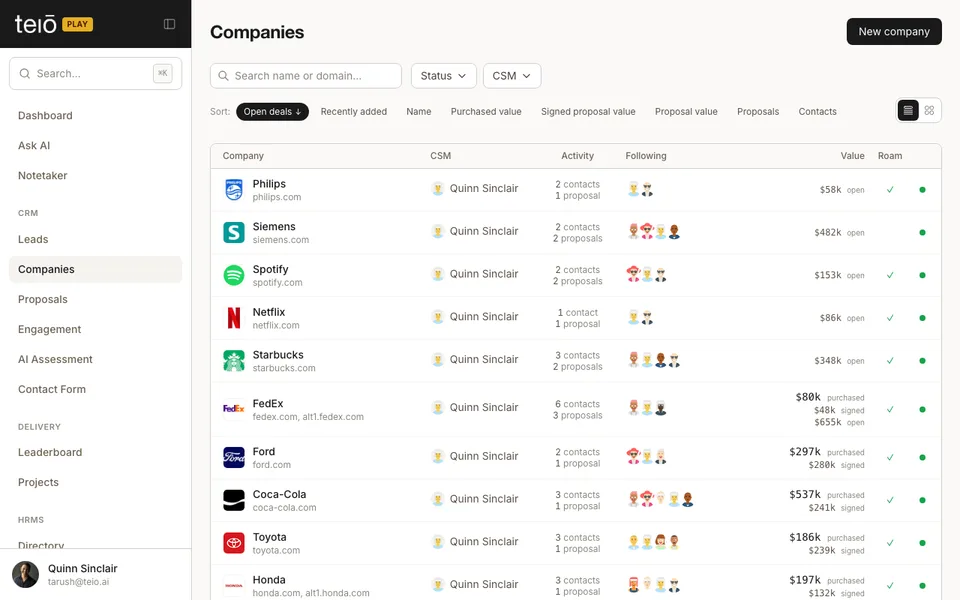
Every customer in one place. Open a company and you get the points of contact, billing, linked proposals and projects, and a full conversation timeline: every email, meeting, and channel message with that customer.
Proposals
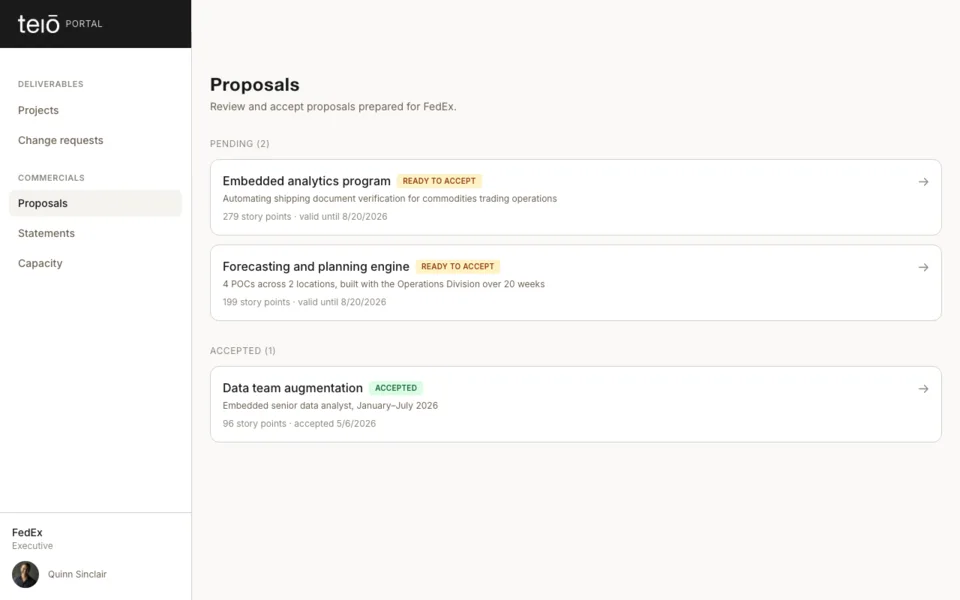
We've automated 90% of proposal building. AI breaks the work down using our methodology, looks at past tasks and how long they took, gauges relative complexity, and uses statistical modeling to assign value. AI drafts the proposal and lays out the payment options. Customers view the full proposal with pricing and accept online. We then track sentiment, close probability, and estimated start date, which we use to plan resources.
Delivery
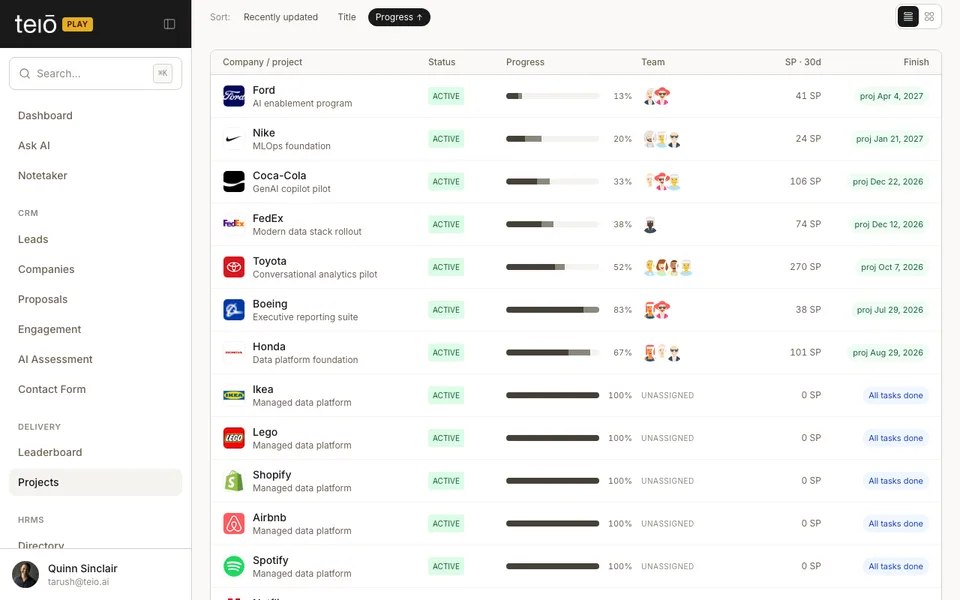
Every project broken into phases, every task with an engineer and story points, so you can see exactly what's done, what's in progress, and what's left. Scope changes come in as change requests the customer approves right in the portal.
Gamification, performance and engagement (AI enablement)
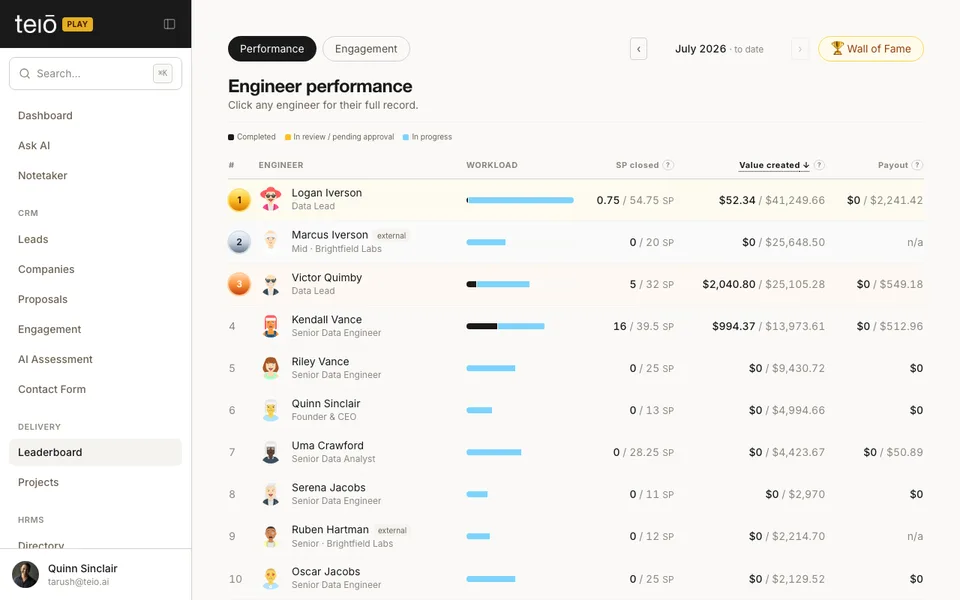
This is the end state for AI enablement: you can't enable something you can't measure. Payouts depend on performance and how much work engineers actually ship. Everyone starts on a standard base salary, and our top engineer makes 2 to 3x what a good engineer makes. We also measure engagement: activity on the platform, how much AI and Claude Code people are using, time in Roam (our virtual office), all-hands participation, role channels, and surveys. It all rolls into an engagement score out of 10, and the wall of fame crowns each month's champions.
HRMS
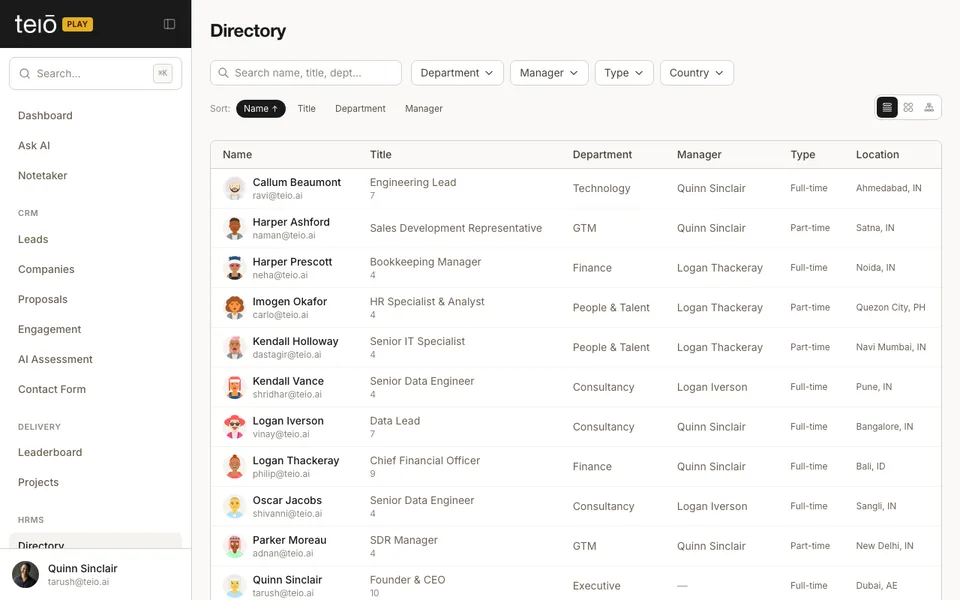
The directory with an org chart view, profiles, roles and exactly what each one can access. HR gets leave tools, onboarding, offboarding, anonymous surveys, all-hands tools and per-person all-hands attendance scoring.
Finance
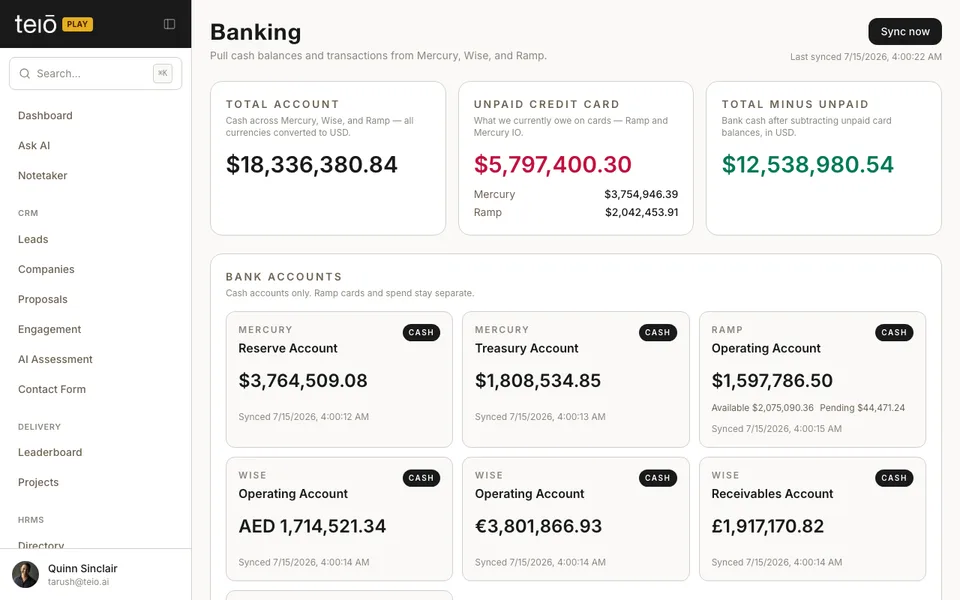
Accounting and banking. Live cash across every account, card, and currency, plus monthly customer statements generated straight from delivery data. More to come here: projections, AP and AR optimization.
Ask AI
Ask AI is the glue which brings everything together. Here it's answering "How do we find $500k of new revenue?" Watch the reasoning steps. It pulls the lead pipeline and customer roster, spins up parallel research across accounts, reads each briefing, understands sentiment and comes back with a ranked plan. When I ran this on our production instance it goes 67 reasoning steps deep before answering.
Notetaker
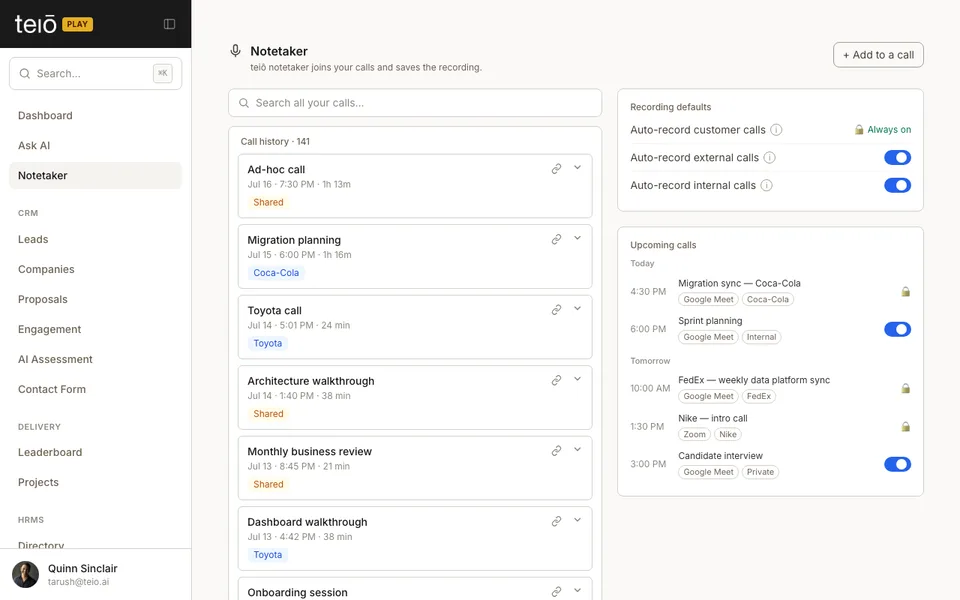
We built our own notetaker so the full context of every call is available to the right folks out of the box. It reads the calendar and joins calls automatically. Customer calls are always recorded, the rest is a toggle. Every call is filed against the right company with the summary, the transcript, who was on it, and who can see it. And since the call lives next to everything else, you can ask AI about it right from the call page.
What it costs us to run
Contrary to market sentiment, we are not spending $10k/month on tokens. The platform costs us:
- Hosting: $26/month
- AI tokens: $110/month
- External databases, transcripts, other tools: $20 to 30/month
Under $200 a month, and it replaces our entire software stack. Separately, the full company has Claude teams, and users are moved to higher tiers when we see their engagement and usage of Claude Code go up. When you purposely build something it's incredibly efficient and an order of magnitude cheaper than rolling out SaaS off the shelf, before you add up the external cost of maintaining those tools. Note: our results are not typical. Your results will vary based on your data volumes, size and usage. None of this is indicative of what your costs would be.
We're opening this up
We're now at a point where we have started building 100% custom operating systems for companies. We've done pilot projects and the results speak for themselves. Here's how it works:
- A 100% custom operating system built for you
- Initial version live in 4 to 6 weeks, complete build in 3 months, and month 4 is focused on training and transfer. We have developed agents that pull from the teiō codebase to build your own OS. That's how a rollout that took us 6 to 8 months compresses into weeks.
- You own 100% of the code. Zero licensing fees.
- Built for a handoff, not for us to own. We teach your engineers agentic software engineering so your internal team can maintain and extend it after handoff.
- Pricing is based on output: we charge based on the modules you want us to build. We don't charge SaaS, for time, or for engineers.
Note these times can vary depending on the number of modules and the complexity of your use cases. The timeline above is what we expect for a six-module system. The teiō platform currently is a 10-module system with the modules listed above.
FAQ
What exactly do you get?
How do we price?
How long does it take?
Can you build things other than operating systems?
What about security?
Which foundation models do you support?
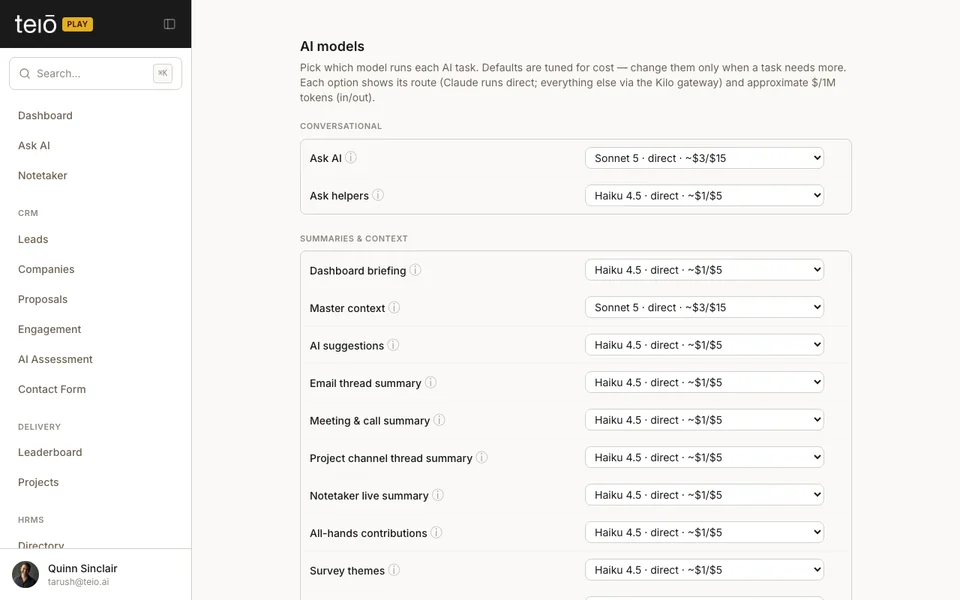
We build using Claude, either through our account or your own Claude subscription. Inside the platform you can plug in any API. We use our direct Claude API key, plus the Kilo gateway to support models outside Claude when required. Here's the model settings screen, where you pick which model runs each AI task.
What do you use to build?
What about vibe coding? What are the risks?
What prevents us from doing this in-house?
What about maintenance and updates?
Can you advise us instead of building?
What's the long-term strategy?
If you're interested, want a deeper demo, or want access to the play environment, reach out.
Tarush